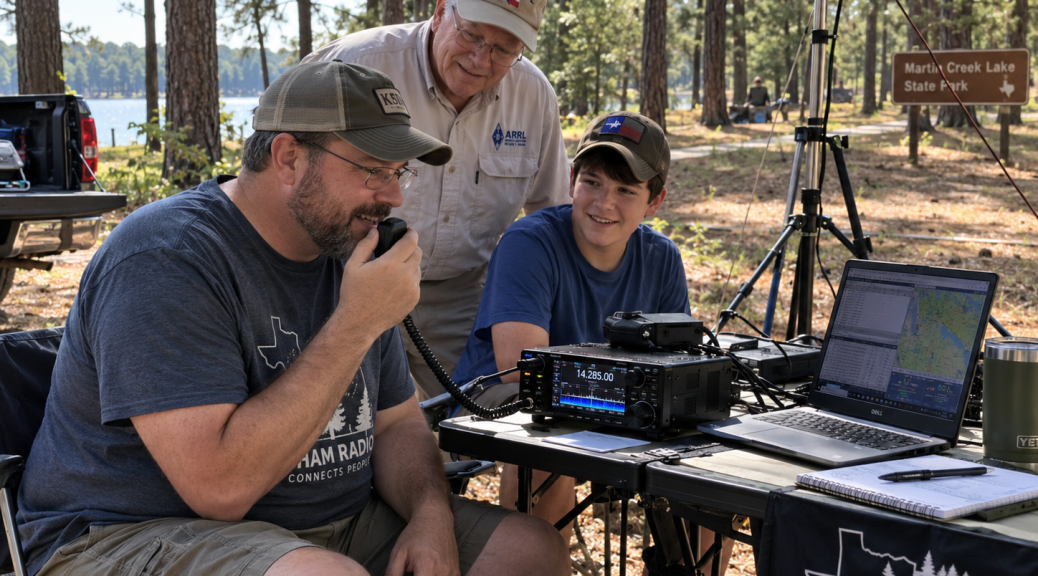
Imagine sitting at a picnic table in East Texas, connecting a radio to an antenna, and hearing someone answer from another state. On another day, with the right setup and conditions, that answer might come from another country.
That’s one part of amateur radio, better known as ham radio. But long-distance conversations are only the beginning.
So, what is ham radio?
Amateur radio is a hobby and a communications service in which licensed operators use radio equipment to communicate, learn, and experiment. The people who participate are often called “hams.”
In the United States, amateur radio operators are licensed by the Federal Communications Commission, or FCC. We’ll cover how to become licensed in a future article. For now, you don’t need an electronics background to understand the appeal.
A radio contact might be a conversation across Nacogdoches, a quick exchange with someone across the country, or a hello from halfway around the world. How far you can reach depends on your equipment, antenna, frequency, conditions, and the way you communicate.
Sometimes the fun is the conversation. Sometimes it’s the surprise of where your signal ends up.
Is it the same as CB radio?
Both let people communicate by radio, but they’re different services.
CB, short for Citizens Band, uses a defined set of channels and doesn’t require an individual FCC license in the United States. Amateur radio requires licensing and offers access to a wider range of frequencies and ways to communicate, along with opportunities to build and experiment with equipment.
There’s room to enjoy both. Someone who likes chatting on CB might also find plenty to enjoy in ham radio.
There’s more than a microphone
Ask several hams what they enjoy, and you may get several different answers. The hobby includes:
- Voice conversations: Catching up with nearby friends or meeting someone far away.
- Morse code: Sending messages using patterns of short and long signals.
- Digital communication: Connecting radios to computers to exchange text, images, or other information.
- Satellites: Communicating through amateur radio satellites orbiting Earth.
- Portable operation: Taking a radio and antenna to a park, campsite, or other outdoor spot.
- Experimenting: Building an antenna, adjusting equipment, and seeing what works.
Some operators enjoy contests, trying to make as many contacts as possible within a set time. Others collect contacts from different places or simply enjoy a relaxed conversation.
You don’t have to enjoy every part of the hobby. You can find the part that makes you want to turn the radio on.
Why bother when we have smartphones?
Because making a connection yourself can be fun.
Sending a message on your phone is convenient. Sending one through a radio system you’ve assembled offers a different kind of satisfaction. It’s a little like the difference between buying vegetables and growing a garden.
Modern ham radio also makes use of computers, digital technology, GPS location information, and internet-linked systems. Some methods use those tools; others can work independently of phone networks and the internet.
Public service is another reason people participate. Trained volunteers can help with communications at community events or supplement normal communications during emergencies. That provides another option when appropriate, rather than replacing police, fire, or professional emergency systems.
For others, the draw is friendship, preparedness, technology, or the chance to try something new.
Start with a little curiosity
Here in East Texas, the Nacogdoches Amateur Radio Club, W5NAC, gives that curiosity a local starting point. Our website has information about club meetings, getting licensed, and becoming involved in amateur radio around Nacogdoches.
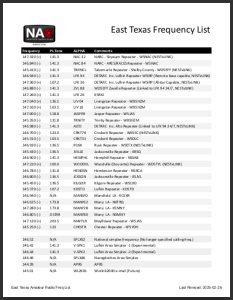
 KE5PQJ’s program at the August NARC Meeting – Decoding P25 with your PC. Download the