So you pass the test, get your call sign, and officially become a licensed amateur radio operator.
Now what?
Quite a bit, actually.
One of the great things about amateur radio is that getting your license isn’t the finish line. It’s more like getting the keys to a very large playground. You can start simple, explore what interests you, and discover entirely new parts of the hobby as you go.
Talk Around Town
For many new operators, the first experience is talking through a repeater.
A repeater is a radio station that receives your signal and retransmits it, usually from a higher location. That can allow a relatively small handheld radio to reach people much farther away than it could on its own.
Local repeaters are a great way to meet other radio operators, participate in scheduled radio nets, ask questions, and become part of the local amateur radio community.
And sometimes the most interesting contact isn’t halfway around the world. It’s another ham a few miles down the road.
Reach Far Beyond East Texas
Depending on your license privileges, equipment, antenna, frequency, and radio conditions, amateur radio can also let you communicate across Texas, across the country, or around the world.
That’s one of the experiences that keeps many hams interested for years.
There is something different about hearing someone hundreds or thousands of miles away and knowing the connection is being made through radios and antennas at each end.
Sometimes the conditions cooperate beautifully.
Sometimes they don’t.
Figuring out why is part of the hobby.
Try Digital Communication
Modern amateur radio isn’t limited to voice.
Hams use computers and radios together for many types of digital communication. Some modes can exchange short messages or information even when radio signals are extremely weak.
Others combine radio with internet-linked systems, mapping, logging software, and digital voice.
You don’t have to understand all of that on your first day. In fact, most of us are still learning something new.
That’s part of the fun.
Talk Through a Satellite
Yes, satellites.
Amateur radio operators can make contacts using amateur-radio satellites orbiting Earth. With the right equipment and some practice, a radio signal can travel from your station up to a satellite and back down to another operator somewhere else within its coverage area.
It’s a pretty good reminder that “ham radio” can mean a lot more than two people sitting beside large radios in their homes.
Take Radio Outside
Ham radio can also go wherever you go.
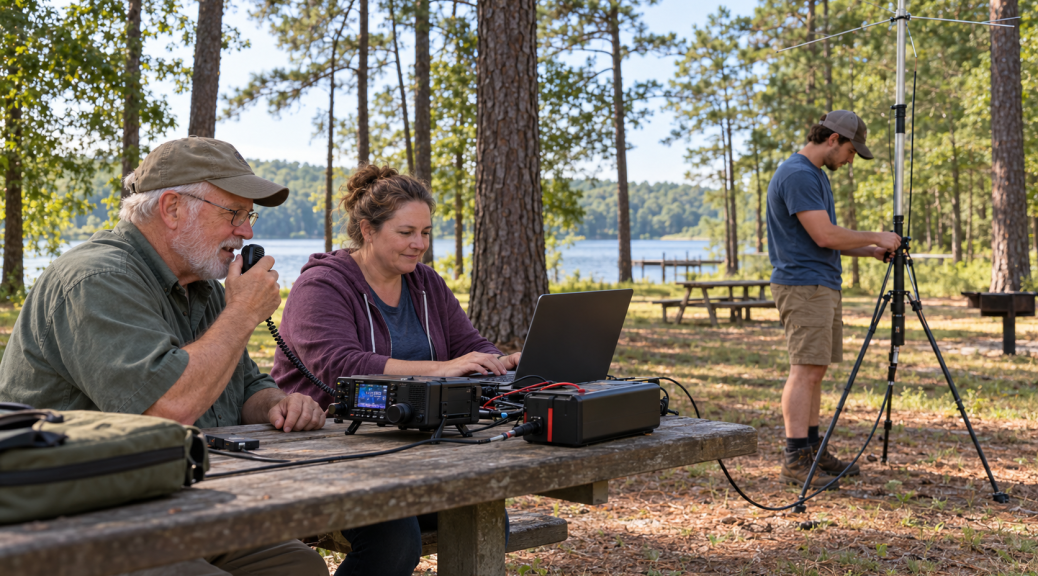
Operators set up portable stations at parks, campgrounds, community events, temporary locations, and sometimes just in the backyard.
A portable setup might include a small radio, battery, laptop or tablet, and an antenna supported by a lightweight mast—or perhaps one of those East Texas pine trees that conveniently happens to be standing nearby.
For people who enjoy camping, parks, experimenting with antennas, or simply being outdoors, portable radio can become a hobby within the hobby.
Learn How Things Work
A ham radio license also gives you room to experiment.
You might try building an antenna, learning why one antenna works better than another, connecting a radio to a computer, experimenting with digital modes, or seeing how changing radio conditions affect a signal.
You don’t have to be an engineer.
Many hams learn by asking questions, trying something, making mistakes, and trying again.
Help When Communication Matters
Some amateur radio operators also participate in public-service events, severe-weather activities, emergency exercises, and preparedness efforts.
Ham radio doesn’t replace police, fire, EMS, cellular networks, or professional emergency communication systems.
It can, however, provide another communication option and sometimes help supplement normal systems when appropriate.
For some operators, public service becomes an important part of the hobby. For others, their interests may be satellites, contests, digital modes, portable operating, or simply talking with friends.
That’s the point.
There isn’t just one way to enjoy amateur radio.
Your License Is Really a Starting Point
One person may spend years talking on local repeaters. Another may chase contacts around the world. Someone else may build antennas, experiment with computers, work satellites, operate from parks, or enjoy several of those things at once.
A ham radio license opens the door.
What you do after that is largely up to you.
If any of this sounds interesting, the Nacogdoches Amateur Radio Club, W5NAC, is a great place to meet people who are already exploring different parts of the hobby—and who remember what it was like to be the person asking, “Okay, I’ve got my license. Now what?”